
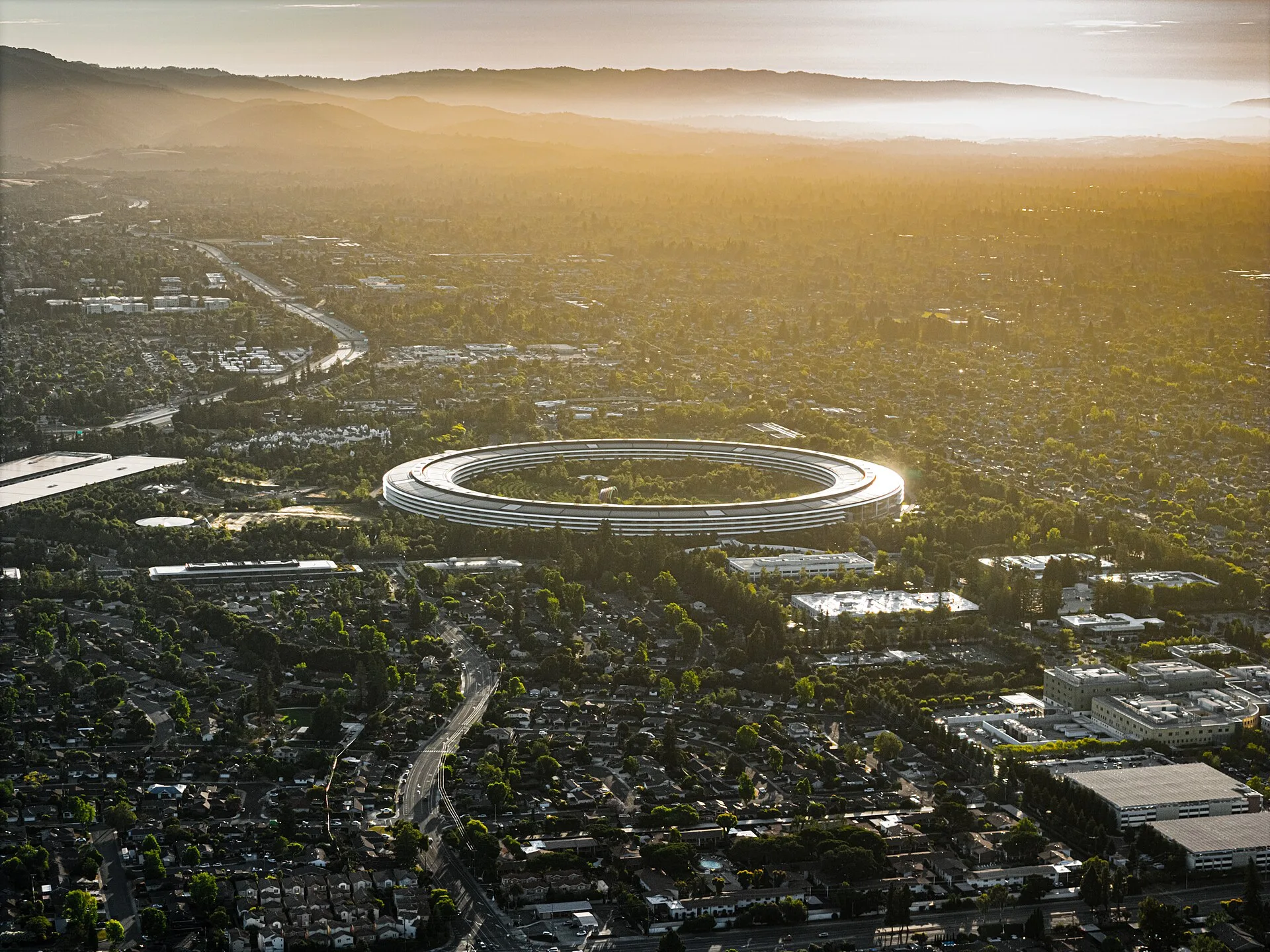
Updated 3 September 2026. Apple (AAPL) closed at $324.96 on 2 September, down 0.05% on the day after a 2.61% jump the session before, in a day range of $323.53 to $328.40. Market capitalisation is about $4.74 trillion. The company’s “Surprise and shine” event lands on 9 September at 10:00 Pacific / 13:00 Eastern – the first keynote of John Ternus’s tenure as chief executive, six days after his pay package became public.
Verdict: the pay filing and the keynote are the same story told twice. Ternus is paid to beat the S&P 500, not to match it – 75% of a $55 million target award rides on relative total shareholder return – and the 9 September stage is where he first has to show what that mandate looks like. The stock is priced for it already: the consensus 12-month target of $324.45 sits fractionally below the current price, so the street is not underwriting upside into the event.
Key facts
- Spot: $324.96 at the 2 September 2026 close (16:00 EDT), down $0.17 or 0.05%; previous close $325.13 – stockanalysis.com
- Range: day range $323.53 to $328.40; 52-week range $225.95 to $344.57, putting the stock about 6% below its 52-week high
- Market cap: approximately $4.74 trillion
- Consensus target: $324.45 over 12 months – roughly 0.2% below spot, so the analyst panel is priced for flat, not for a re-rating
- Next catalyst: the “Surprise and shine” event, 9 September 2026, 10:00 PT / 13:00 ET, streamed on Apple’s event page, the Apple TV app and YouTube – CNBC
- CEO pay: $3 million salary and a $55 million fiscal 2027 target equity award for Ternus, 75% performance-weighted; Tim Cook takes $45 million as Executive Chair, split 50/50
Apple’s new chief executive is paid on a tighter leash than the man he replaces. The Form 8-K/A Apple filed on 1 September 2026 — timestamped 16:30:35 New York time, half an hour after the closing bell — set John Ternus‘s salary at $3 million and his fiscal 2027 target equity award at $55 million, 75% of it vesting on Apple’s total shareholder return relative to other companies in the S&P 500. Tim Cook, moving to Executive Chair, takes a $45 million award split 50/50. Run the arithmetic and an oddity falls out: Cook’s unconditional, time-based equity is worth $22.5 million against Ternus’s $13.75 million. The Executive Chair’s guaranteed stock is roughly 64% larger than the new CEO’s.
That asymmetry cuts against the reflex reading that a succession showers the successor. Ternus’s package is bigger in total — $58 million against $47 million at target — but far more of it is contingent. And because the amendment landed after the close, Tuesday’s tape was no verdict on it. Apple rose 2.61% to $325.13, the only large gainer in a red megacap session in which Nvidia fell 1.51% and Tesla 3.22%, per stockanalysis.com. Whatever drove that move, the pay package was not yet public.
What the filing says
The transition was set out in Apple’s Form 8-K of 20 April 2026, filed when Apple announced the handover in April. The board appointed Ternus, then 50 and Senior Vice President of Hardware Engineering, on 17 April, with Arthur Levinson moving from Chairman to Lead Independent Director. Apple promised an amendment carrying the pay detail “within four business days after the information is determined.”
That amendment arrived 134 days later, on the day Ternus started: shareholders learned what their CEO costs after he had the job. Cook’s $2 million salary begins 26 September, the close of Apple’s fiscal 2026.
The Form 3 is more revealing
Ternus’s Form 3, filed the same day, shows him holding just 34,155 Apple shares outright through his trust — about $11.1 million, roughly a fifth of one year’s target award. Against that sit 305,171 unvested restricted stock units, worth about $99.2 million at target and at $325.13. Close to 90% of his Apple equity is unvested, and several tranches are performance RSUs paying between 0% and 200% of target. A separate Form 4 records the prorated first-day grant: 7,690 units, an implied $325.10 against the $325.13 close.
Apple has not commented beyond the filing, signed by Jennifer Newstead, Senior Vice President, General Counsel and Government Affairs. Its public framing remains April’s. “John Ternus has the mind of an engineer, the soul of an innovator, and the heart to lead with integrity and with honor,” Cook said in Apple’s announcement. Levinson called him “the best possible leader to succeed Tim.” Ternus was shorter: “I am profoundly grateful for this opportunity to carry Apple’s mission forward.”
Structure matters more than the total
For institutional holders, the weighting is the story. A 75% performance loading means Ternus is paid not for Apple going up, but for Apple going up more than the field. The drafting is careful where it counts: the benchmark is “other companies in the S&P 500,” excluding Apple from its own comparator set. At roughly $4.75 trillion, a self-referential benchmark would have let index weight do the work performance is meant to do.
Having followed this succession since the April filing, the detail I keep returning to is Cook’s retirement clause. If he retires on or after the first anniversary of the fiscal 2027 grant date, his award still vests, subject to performance, but settles on the original schedule. That is a soft one-year handcuff and the closest thing to a public timetable for his exit: leaving earlier puts $45 million at risk. Expect him in the chair into fiscal 2028.
The open question is what Ternus does with a mandate priced on relative outperformance while carrying the AI backlog he inherits. A CEO paid to beat the index has more reason to take swings than one paid to hold a franchise — arguably the point of the 75/25 split, and something that sharpens the bull and bear cases into the handover, in a cohort where Nvidia’s own quarter reset what megacap growth looks like.
What the 9 September event changes for AAPL
Apple confirmed the date on 26 August, and the framing was deliberate: this is the first product keynote run by a chief executive other than Tim Cook since 2011. Ternus, who took over on 1 September, told staff in his first memo as CEO to expect a “huge launch next week that’s going to be phenomenal” – unusually forward language from an executive whose public register has been engineering-flat.
The expected line-up, per AppleInsider, is the iPhone 18 Pro and 18 Pro Max, the Apple Watch Series 12 and Ultra 4, and – the reason this event is not routine – Apple’s first foldable iPhone, reported to pair a 5.5-inch outer display with a 7.6-inch inner screen. The standard, non-Pro iPhone 18 is not expected until spring 2027, which splits the usual autumn cycle in two for the first time.
For the stock, the mechanism is narrower than the coverage will be. A foldable is a new price tier and a new unit-economics question, not an immediate revenue line – it ships into a single quarter at low volume. What a launch event moves in the near term is the market’s estimate of average selling price and upgrade rate for the December quarter. That is why guidance commentary in late October usually matters more to the tape than the keynote itself.
The second thing to watch is what Ternus says about artificial intelligence, or declines to say. He inherits an AI backlog that predates him, and a pay package explicitly indexed to beating the rest of the S&P 500 in a period when the index’s returns have been dominated by AI infrastructure names. A hardware-only keynote answers the product question and leaves the compensation question open.
Where the stock actually sits
Apple is not trading like a company with an obvious catalyst in front of it. The stock sits about 6% below its 52-week high of $344.57 and roughly 44% above the 52-week low of $225.95, and the consensus 12-month target of $324.45 is fractionally below the last close. That is the profile of a name the street considers fully valued rather than mispriced in either direction.
| Reference level | Price | Distance from $324.96 |
|---|---|---|
| 52-week low | $225.95 | -30.5% |
| Consensus 12-month target | $324.45 | -0.2% |
| 2 September close | $324.96 | – |
| 2 September intraday high | $328.40 | +1.1% |
| 52-week high | $344.57 | +6.0% |
These are reference levels drawn from the traded range and the published analyst mean, not price forecasts. Note that the consensus number sitting below spot is itself information: it means the average target has not been revised up to meet a stock that has already run, and revisions after the keynote are the thing to watch rather than the level today. The longer-range bull and bear arguments are set out separately in FinanceFeeds’ AAPL scenario analysis.
Quick take: Ternus starts with a $3 million salary, a $55 million target award that is three-quarters conditional on beating the index, and six days to his first keynote. The pay structure tells you the board wants swings; the analyst panel, with a mean target below the current price, is not yet paying for them. The 9 September event is the first data point on which of those two views ages better.
Frequently asked questions
What is Apple’s stock price right now?
Apple closed at $324.96 on 2 September 2026, down $0.17 or 0.05% from the previous close of $325.13, in a day range of $323.53 to $328.40, per stockanalysis.com. Intraday quotes move; the last regular-session close is the reliable figure.
When is Apple’s September 2026 event?
Wednesday 9 September 2026 at 10:00 Pacific, 13:00 Eastern. Apple has titled it “Surprise and shine” and will stream it on its event page, the Apple TV app and YouTube.
What is Apple expected to announce on 9 September?
Reporting points to the iPhone 18 Pro and iPhone 18 Pro Max, the Apple Watch Series 12 and Ultra 4, and Apple’s first foldable iPhone with a 5.5-inch outer and 7.6-inch inner display. The standard iPhone 18 is expected in spring 2027 rather than this autumn. None of this is confirmed by Apple before the keynote.
How much is John Ternus paid as Apple CEO?
A $3 million annual salary and a $55 million target equity award for fiscal 2027, of which 75% vests on Apple’s total shareholder return relative to other S&P 500 companies. His unconditional, time-based portion is $13.75 million – smaller than the $22.5 million of guaranteed stock in Tim Cook’s $45 million Executive Chair award.
Is Tim Cook still at Apple?
Yes. Cook moved to Executive Chair on 1 September 2026. His $2 million salary begins on 26 September, the close of Apple’s fiscal 2026. A retirement clause preserves his award if he leaves on or after the first anniversary of the fiscal 2027 grant date, which points to him staying in the chair into fiscal 2028.
What is Apple’s market capitalisation?
Approximately $4.74 trillion as of the 2 September 2026 close.
Do Apple shares usually rise after an iPhone event?
There is no dependable rule, and treating one as if there were is how people lose money. Launch events are heavily pre-reported, so the specification news is largely priced before the keynote; what tends to move the stock is the pricing decision and the guidance that follows in the late-October results, not the presentation itself.
Sources: price, day range, 52-week range, market capitalisation and the consensus analyst target from stockanalysis.com (2 September 2026 close, 16:00 EDT); event date, time and the CEO transition from CNBC; expected product line-up from AppleInsider; compensation and shareholding detail from Apple’s SEC filings linked above.
This article is for information purposes only and is not financial advice. FinanceFeeds does not recommend buying or selling any security. Reference levels and analyst targets describe traded ranges and other people’s published expectations, not outcomes. Always do your own research and consider consulting a licensed financial adviser.